The bay the bus never pulls into
All along Limassol's coastal road the bus stops are recessed into bays. That is a technique for a rural highway — in town it defeats the very thing low-floor buses were bought for.
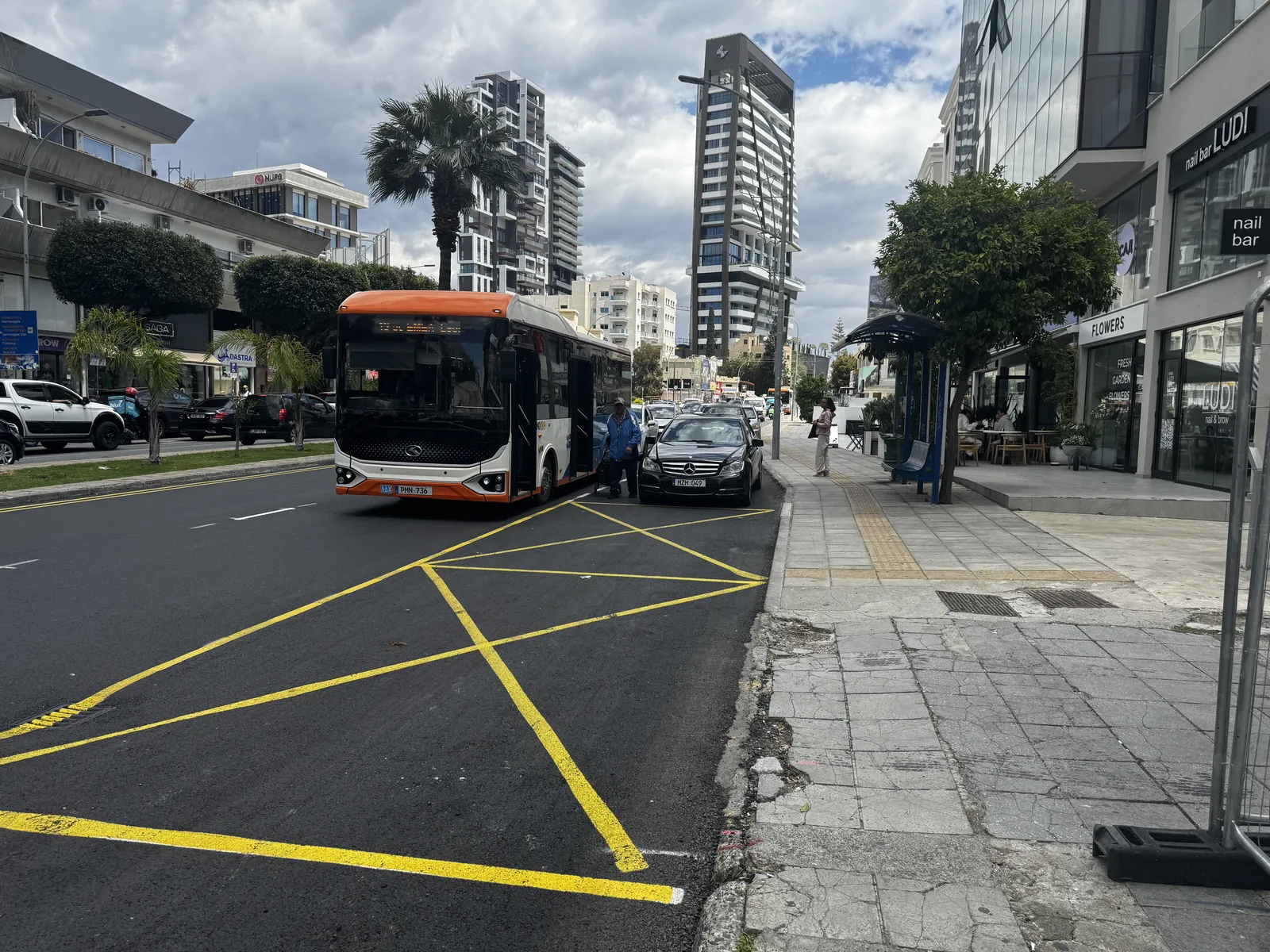
A bay marked out with a yellow box. There is a car in it. The bus has stopped where it could — in the traffic lane. Precisely the situation the bay was built to prevent.
Photo: cy4peopleLimassol’s coastal road is three streets in a row: Spyrou Araouzou in the old town, then 28is Oktovriou, then Vasileos Georgiou I in Potamos Germasogeias. Nearly ten kilometres along the sea, with a 50 km/h limit throughout.4 And for almost all of it the bus stops are built the same way: the carriageway widens locally and the bus is meant to pull out of the traffic lane into a bay.
The intention is clear enough — a stopped bus should not hold up the traffic. In practice neither half works: the bus does not pull in, and the traffic waits anyway.
What actually happens
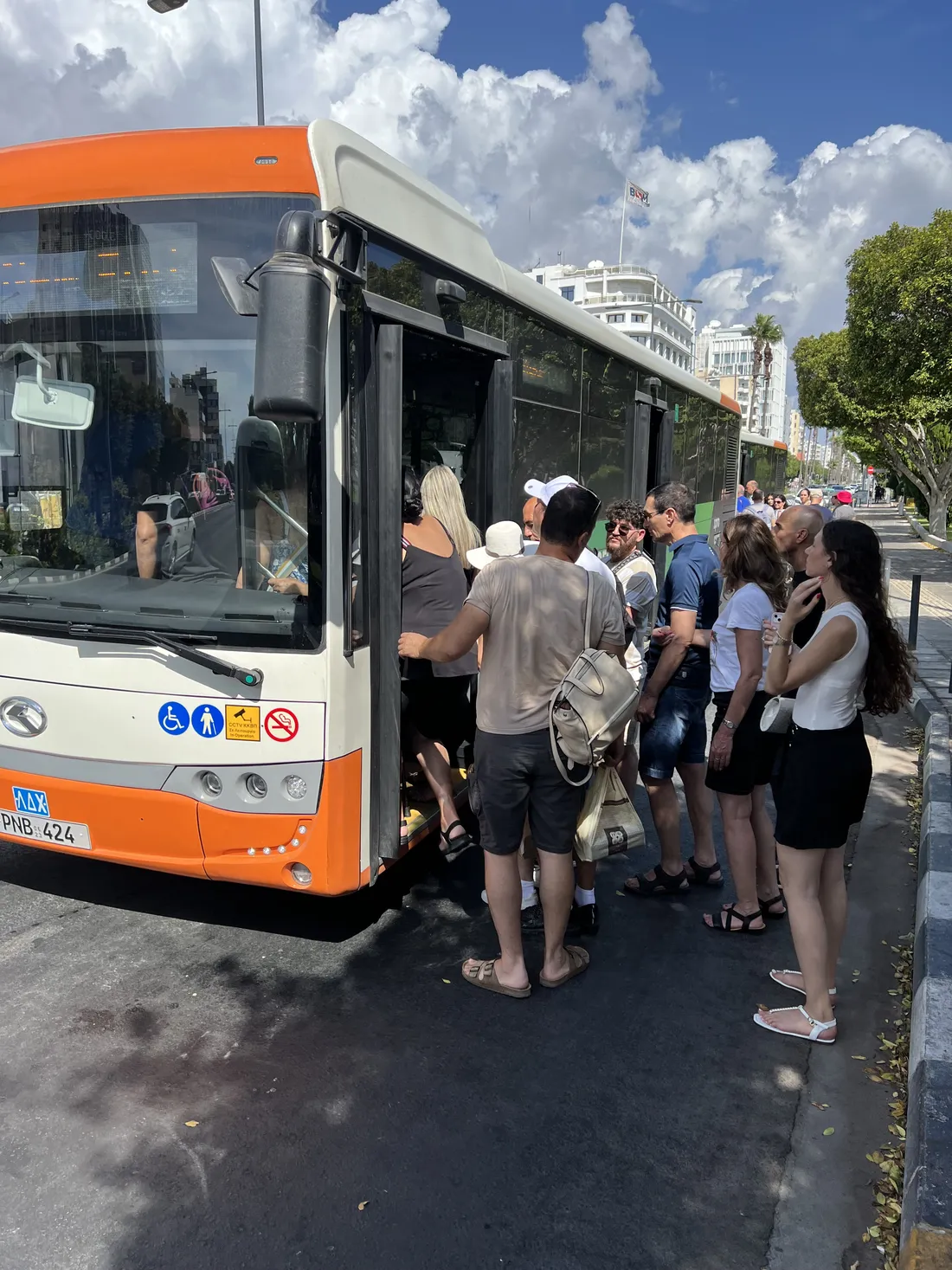
Look at the symbols on the bus: a pushchair and a wheelchair. This is a low-floor vehicle, bought so that people could step on from the pavement with no step at all. They are boarding off the road.
Photo: cy4people. Spyrou AraouzouThe mechanism is always the same:
- the bus cannot get close to the kerb and stops a metre or two out from it;
- the doors open over the carriageway, and passengers step down onto the asphalt;
- the ramp, designed to land on a kerb, has nowhere to go — pushchairs and wheelchairs stay on the pavement;
- the queue to board stands in the road, in the gap between the bus and the kerb.
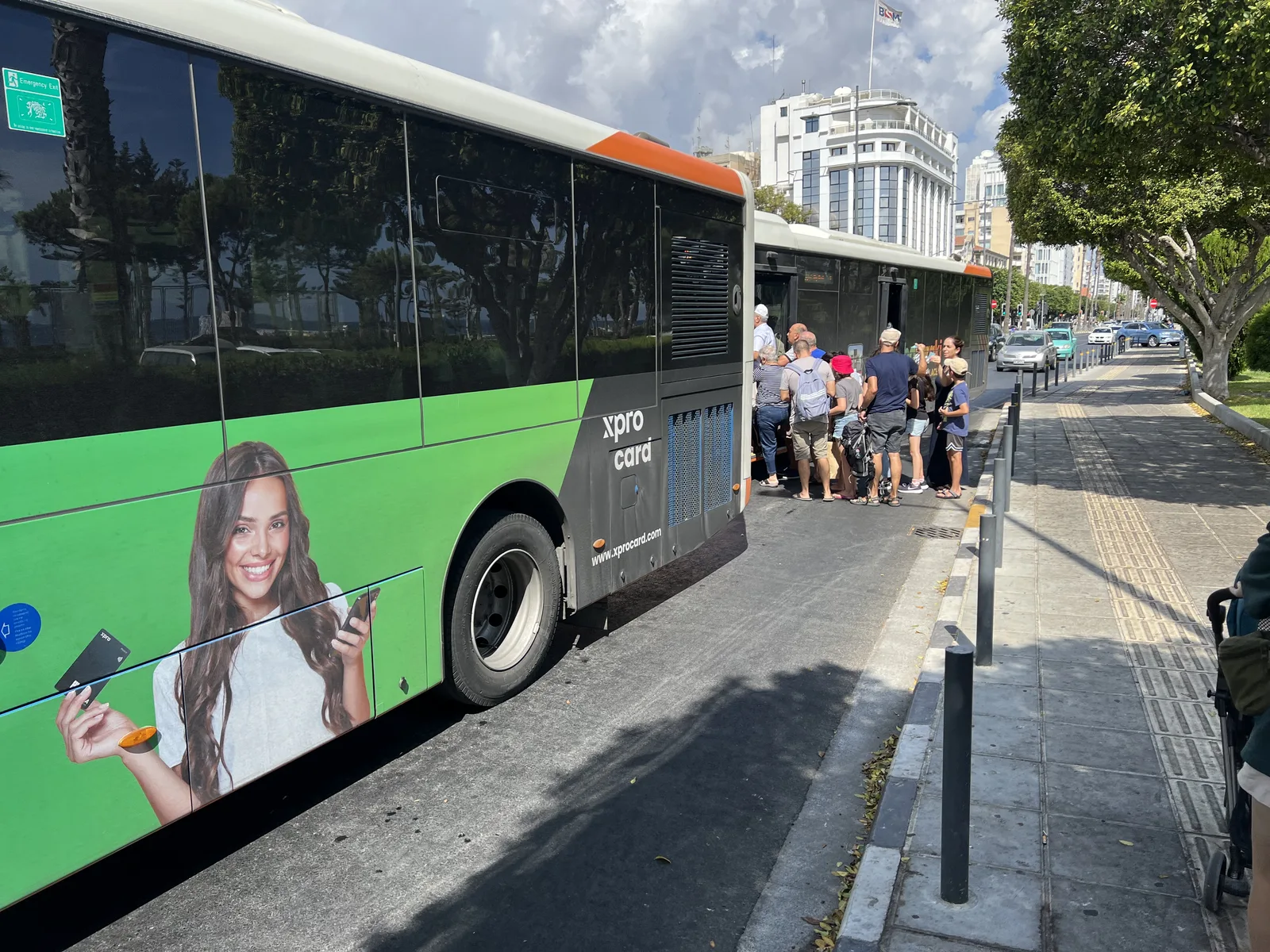
The same stop from behind. The gap between the bus and the kerb is over a metre. On the pavement to the right, a pushchair is waiting — it will have to board from the carriageway.
Photo: cy4people. Spyrou AraouzouA bay is a technique for a rural road
This is not a Cypriot invention, and nobody blundered. Bus bays are a standard element with a proper field of application. It just is not this one.
The American guidance on bus stop design lists the conditions under which a bay makes sense: more than 250 vehicles an hour in the kerb lane at peak, speeds above 40 mph (64 km/h), dwell times over 30 seconds, sight lines broken by hills or bends.2 The coastal road meets none of them.
London puts it more bluntly still:
London did not stop at a recommendation: it adopted a policy of filling in bus bays on every road with a speed limit of 30 mph (48 km/h) or less. The Cypriot urban limit is 50 km/h.3
Why the bus physically cannot pull in
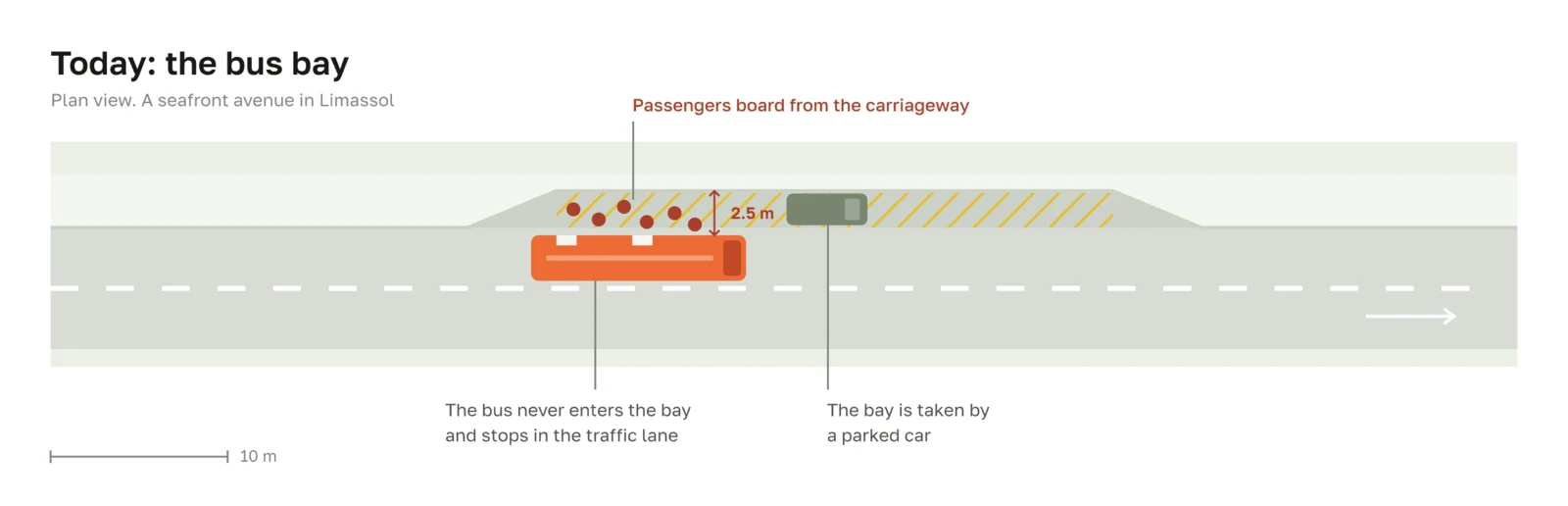
How it works today. The tapers at each end push the bus in at an angle, and the space at the kerb is taken.
Drawing: cy4peopleThis is not about drivers. To end up parallel to the kerb a bus needs a stop long enough to approach, straighten up, stop and pull out again. The minimum is 33 metres; of stops shorter than 25 metres the London guidance says flatly that they do not work.1 Ours are considerably shorter.
From there it compounds:
- the taper puts the bus in at an angle — there is no room to straighten, so the front door ends up further from the kerb than the rear one;
- somebody else’s car is in the bay — a bay looks exactly like a convenient place to stop “for a minute”, and a yellow box does not change that;
- pulling out means giving way — a driver who enters the bay loses their place in the traffic and waits for a gap;
- so drivers stop using bays altogether. This is a documented effect: in heavy traffic, bus drivers simply will not use them.2
The result: a bay built, marked and maintained — standing empty or full of someone else’s car, while the bus stops in the lane. Exactly as if the bay were not there, only worse: the kerb is now further away.
What to do instead
There are two fixes, and both cost less than keeping the bay.
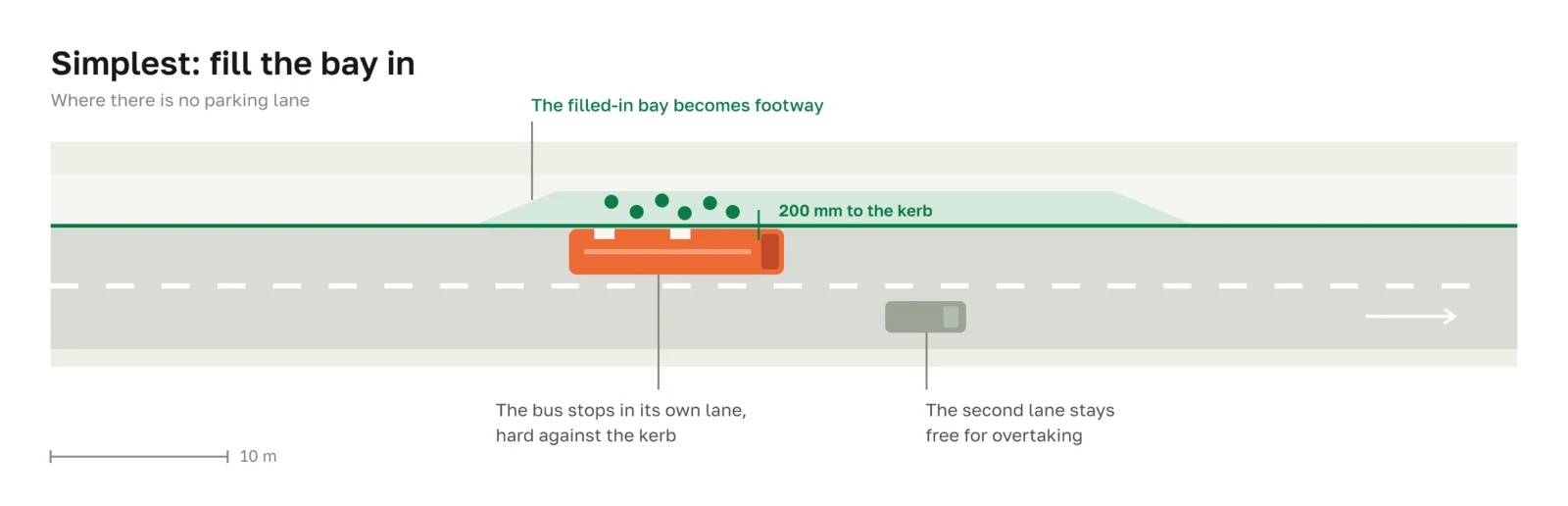
Where there is no kerbside parking — just fill it in. The kerb becomes straight, the bus docks against it, and the former bay turns into footway.
Drawing: cy4people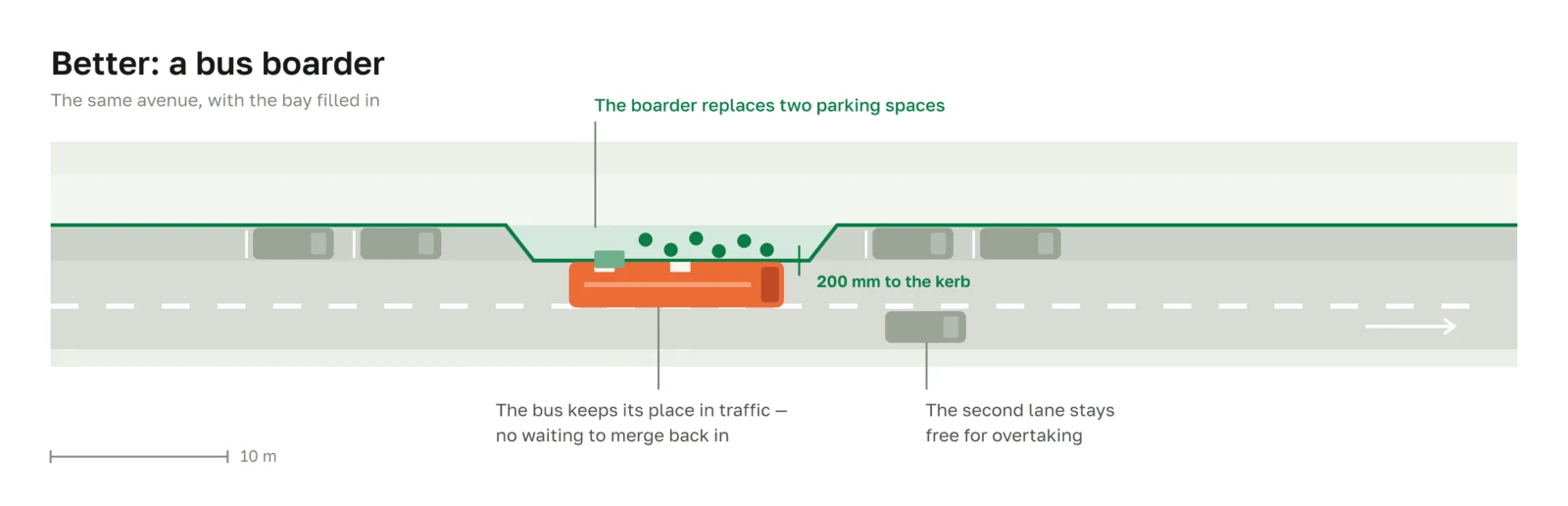
Where there is parking — build the platform out. The boarder takes two parking spaces and the bus docks without leaving its lane. The parking does not disappear; it shifts along by two spaces.
Drawing: cy4peopleLondon measured the result before and after on real streets. Once the bays were filled in, the share of passengers who had to step into the road fell from 3–24% to at most 1%; boarding got 0.5–1 second faster per passenger; bus delay dropped by 2–4 seconds. Illegal parking at the stops fell by 69–83%.1
After boarders were built, the share of buses stopping close to the kerb went from zero to 95% at one of the sites.1
| What we are comparing | Bay | In-lane stop |
|---|---|---|
| Where passengers board from | The carriageway | The pavement |
| Pushchairs and wheelchairs | The ramp has nowhere to land | The ramp lands on the kerb |
| Rejoining traffic | The bus waits for a gap, +2–4 s | Its place in traffic is kept |
| Other cars at the stop | The bay attracts parking | 69–83% less of it |
| Timetable reliability | Dwell times vary more widely | 4 seconds narrower |
| Kerb length used up | More — the tapers count too | Less |
| Cost | Built, then maintained | Asphalt and kerb, once |
The objections that come up first
“The bus will sit in the lane and everyone will queue behind it.” Partly fair: London openly accepts that in-lane stops reduce the capacity of a link. But there are three corrections. The avenue has two lanes — a bus is simply passed on the second one. The kerbside lane in Cyprus is almost always occupied by stopped cars anyway, so the effective width is already one lane. And above all: the bus is already standing in the lane, because it never pulls into the bay. What is on the table is not a new obstruction, but the same one, made official and made useful to passengers.
“We will lose the parking.” A boarder takes two spaces. A bay, meanwhile, sterilises more kerb than any boarder does — the tapers at each end count too.1 On balance the parking goes up, not down.
“It is expensive.” Filling in a bay is asphalt, kerb and paint on one short stretch. Existing bays can also be fixed in part: fill in only the section where the front door lands and leave the rest. That is exactly what London recommends where cars park in bays persistently.1
Where bays are genuinely right
So that this does not read as “bays are always bad”:
- on rural and high-speed roads — above 64 km/h, where stopping in the lane really is dangerous;
- where a hill or a bend hides the stop and a following driver cannot brake in time;
- at termini and layover points, where a bus stands for a long time;
- at stops with very long dwell times — 30 seconds and up.
Limassol’s coastal road is none of these. It is an ordinary town street with a 50 limit, shops, hotels and people pushing prams.
What we recommend
Sources
Transport for London, “Accessible bus stop design guidance” — chapter 8 “Bus bays”, the chapters on the bus stop cage and on bus boarders, and appendices B and C with the before/after measurements — PDF.
Transportation Research Board, TCRP Report 19, “Guidelines for the Location and Design of Bus Stops” — the criteria for using bays, and the finding that above 1,000 vehicles per hour per lane drivers will not use them — PDF.
Speed limits in Cyprus: 50 km/h in built-up areas — Your Europe, European Commission.
Posted speed limits along the coastal road — OpenStreetMap, ODbL.