The street you cannot see for the cars
An ordinary residential street in Cyprus. We erased the parked cars from the photograph — and it turned out there is room for everything at once: a traffic lane, parking, and a pavement wide enough for a pushchair.
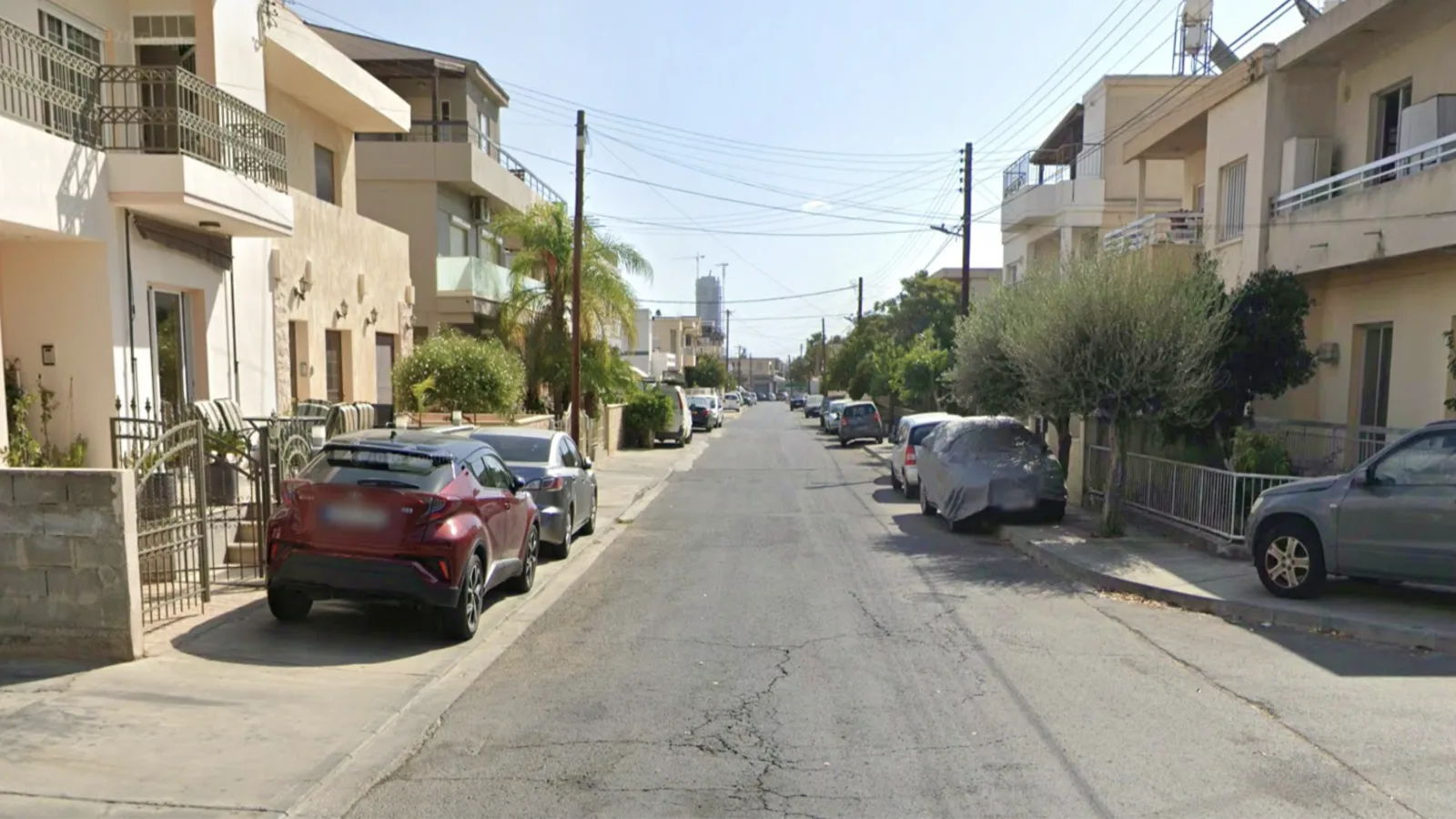
One and the same photograph. Drag the slider: on the right is the street as it is today, on the left the same panorama with the parked cars erased. Nothing else was touched.
Editing: cy4people. Base image: Google Street ViewThis is not the worst street in Cyprus, and it is not a special case. Two-storey houses, breeze-block walls, olive trees along the fence, cables overhead. There is a street like this in every neighbourhood of Limassol, Larnaca and Nicosia. You probably live on one.
Look at the left half of the image again and try to find the pavement.
First, just take the cars away
What you see to the left of the handle is not a proposal and not a dream. It is the same panorama with the parked cars removed and nothing else changed: the walls stand where they stood, the asphalt is the same, the trees are the same, not one centimetre has moved.
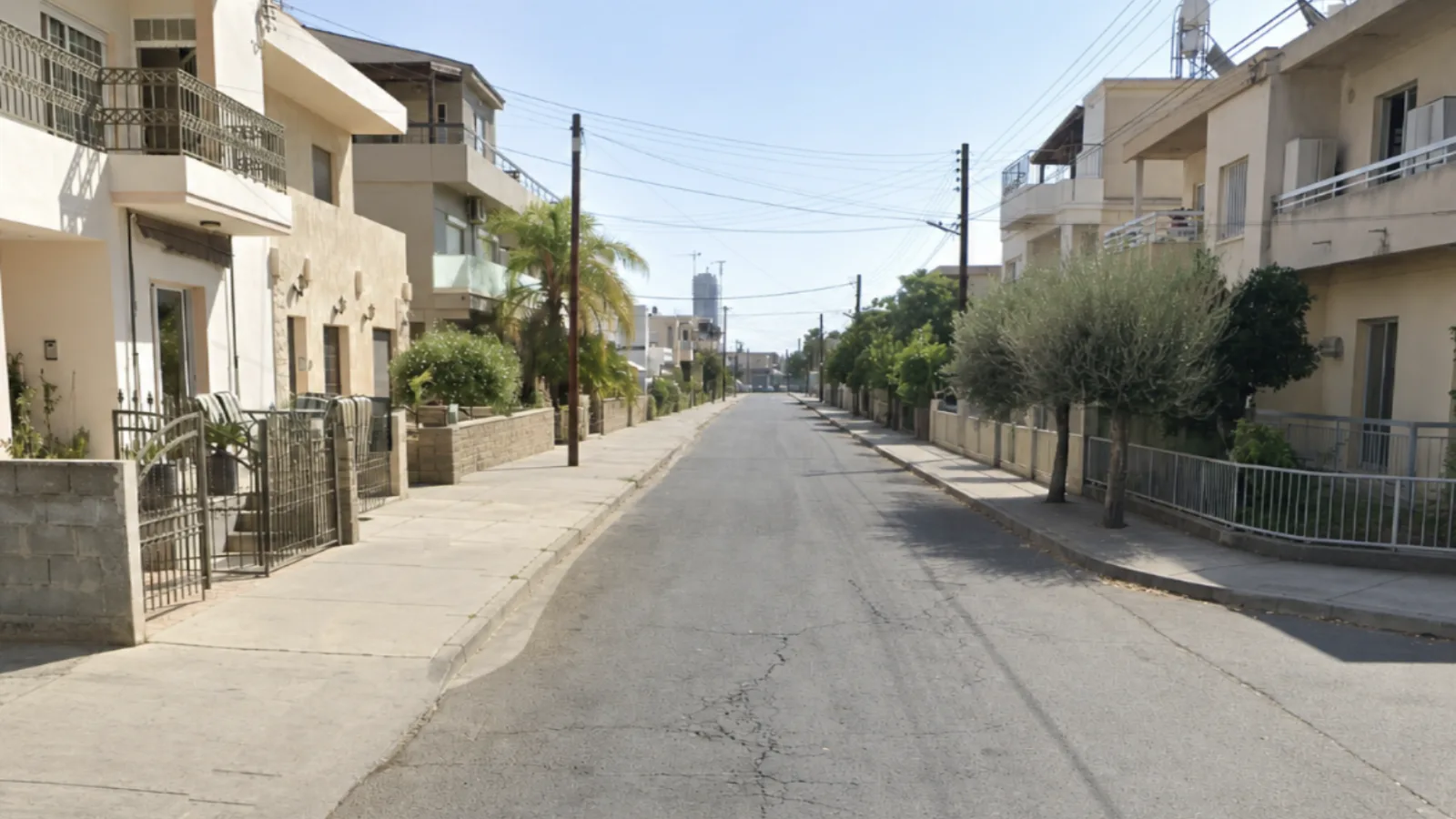
The same street without the cars. A concrete strip runs along the wall on the left, wide enough for two people to pass. Under the olives on the right there is a second one. The street is not narrow. It simply cannot be seen.
Editing: cy4people. Base image: Google Street ViewThe pavement is here. It was built, poured and has been sitting in place for years. The problem is not that there is too little of it — the problem is that it is occupied.
The space exists, it is just taken
And that is not a complaint about drivers. Somebody who has come home puts the car where a car can be put. There are no marked bays on the street, not every house has a yard, and if everyone parked honestly along both kerbs, two cars coming the other way could no longer pass. So each of them puts two wheels up on the paving — not out of arrogance, but so that the neighbour can get through.
Everything else follows on its own: the car stands half on the pavement, the pedestrian walks in the road, and the person with a pushchair turns around and goes the long way. Parking on the pavement is formally an offence in Cyprus. On the street it changes nothing, because the driver has no alternative.
The parking stays — it is just organised
The first thing you hear in response to pictures like these is “you want to take people’s parking away”. We do not. The cars are not going anywhere — they line up in a single row along one side, on markings.
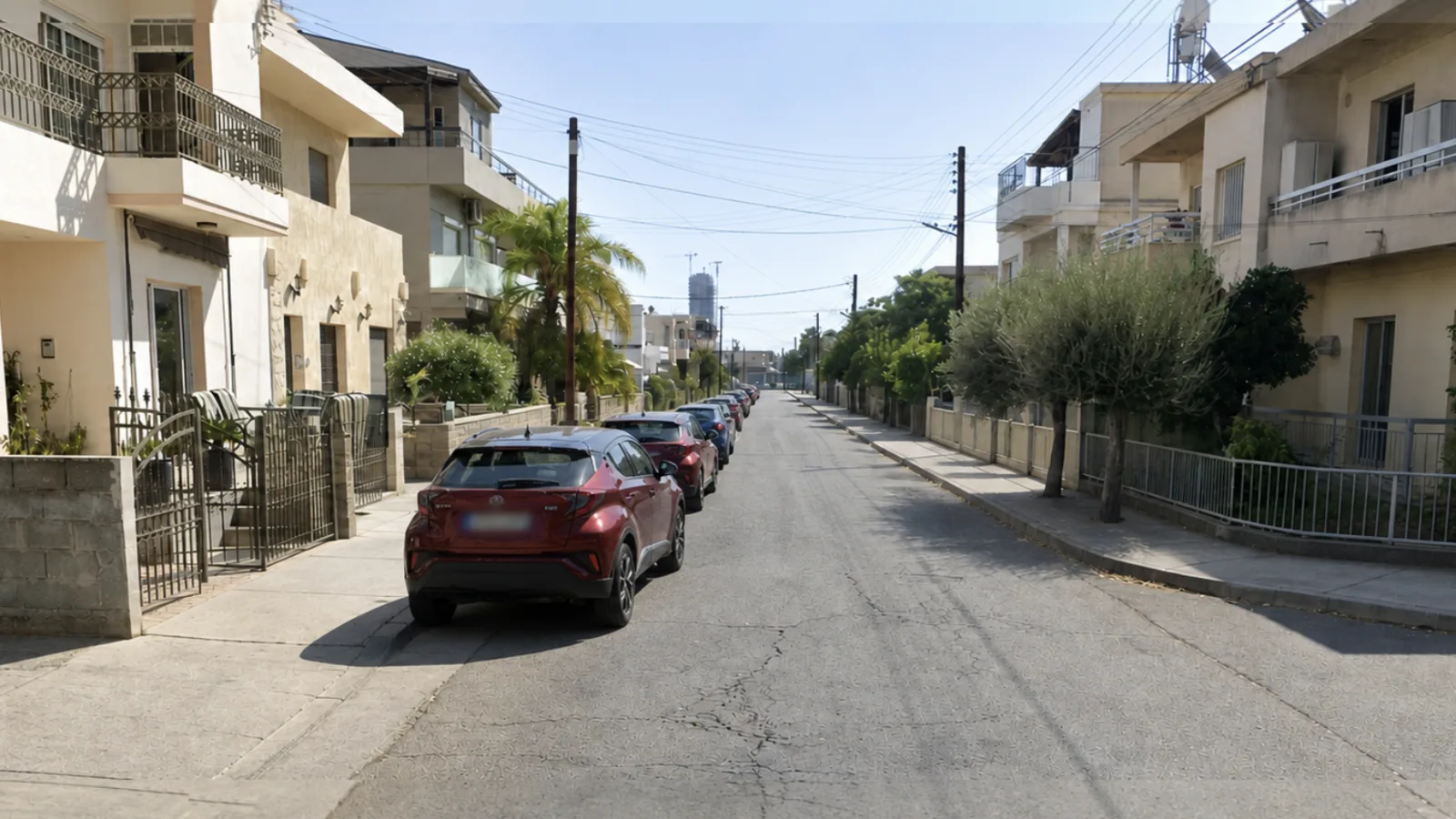
The same cars, the same asphalt. The row takes the two metres the car already takes today — the difference is that those two metres are now counted and marked out, instead of being bitten off the pavement.
Visualisation: cy4people. Base image: Google Street ViewWhat is left over is enough for one traffic lane. That is not a loss: there was never more than one lane here. Two cars coming from opposite directions have never once passed each other on a street like this — it simply was not written down anywhere, and had to be negotiated afresh by two drivers each time.
And then a pavement appears
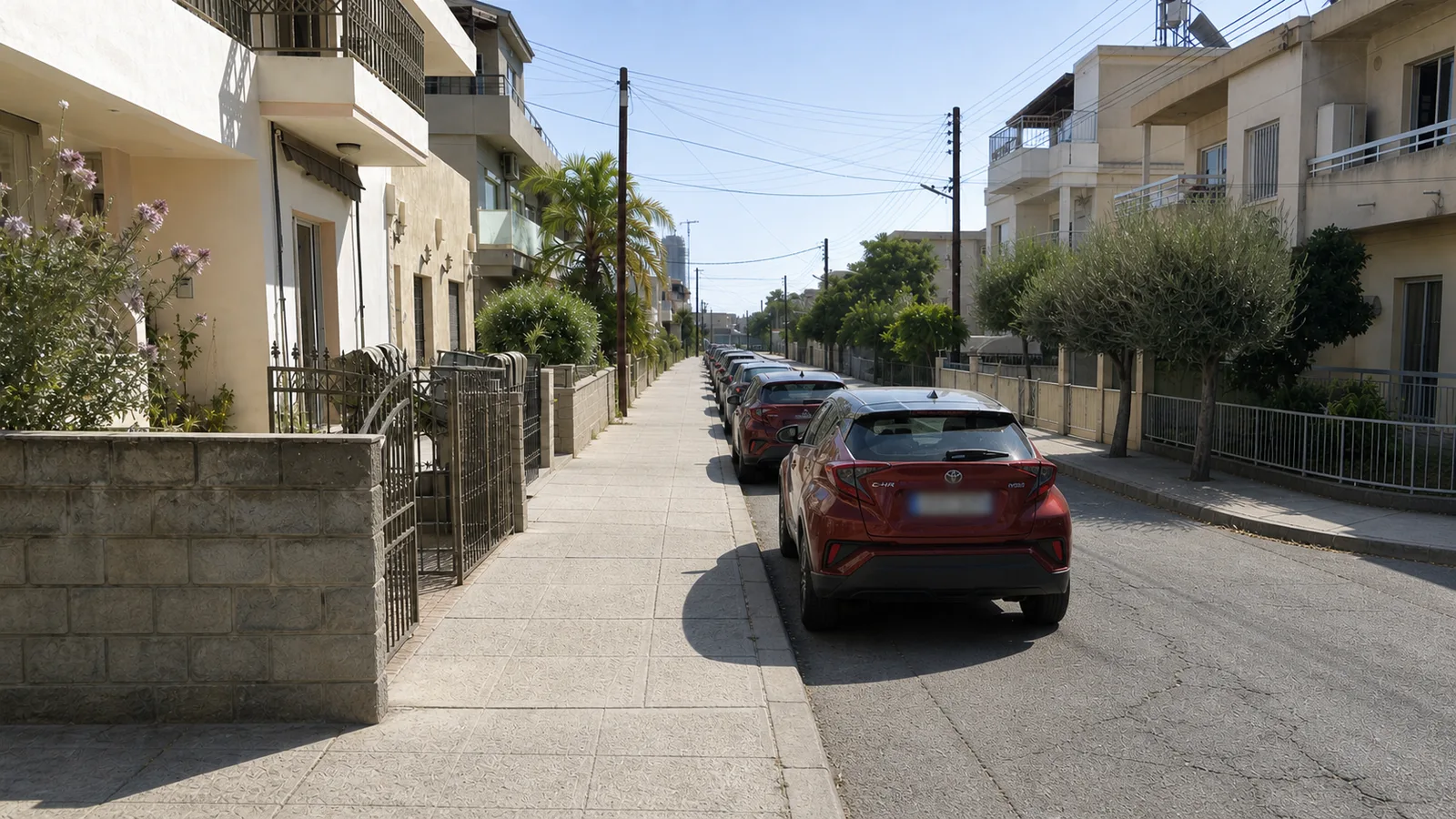
A continuous strip from corner to corner. A metre and a half to two metres of surface along the wall is the minimum at which you can walk down the street with a pushchair, with the shopping, with a walking frame or in a wheelchair.1
Visualisation: cy4people. Base image: Google Street ViewThe difference between edging sideways between a wing mirror and a wall and simply walking looks like a detail — right up until the day you leave the house with a child, with a suitcase, or with your eighty-year-old mother on your arm.
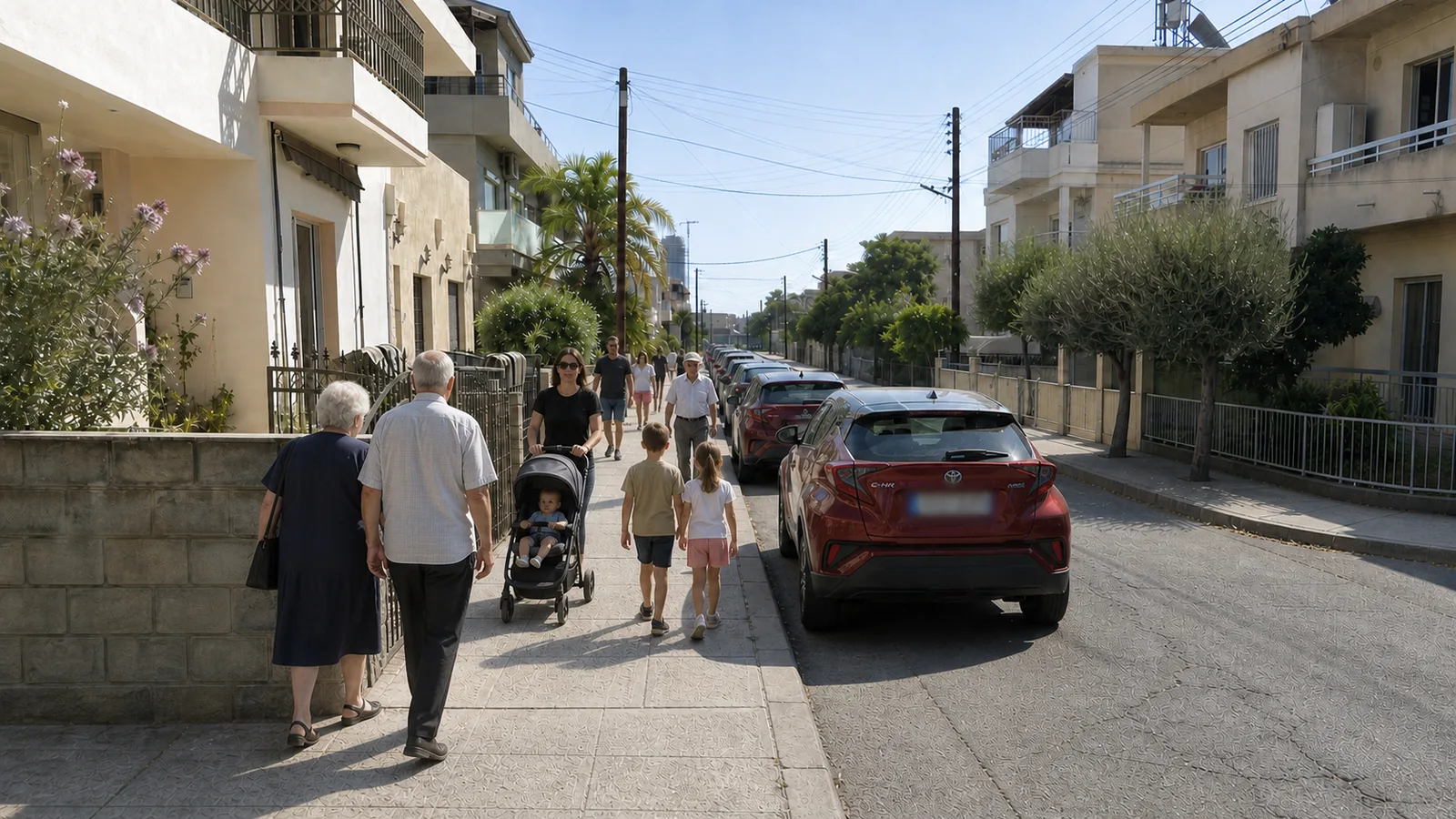
The same street, the same asphalt, the same cars. Exactly one decision has changed: where they stand.
Visualisation: cy4people. Base image: Google Street ViewWhat it takes
Not one wall, not one tree, not one house. Markings, a sign, and bollards or concrete hemispheres where a car would otherwise climb back onto the paving. It is a weekend’s work and an order of magnitude cheaper than any rebuild — which is precisely why it is not frightening to try: if it does not work, it comes back just as fast.
That idea is roughly why this site exists. Almost everything we write about has been solved somewhere already, and the solution almost always turns out to be simpler and cheaper than it first looks. The difficulty is not in the concrete or in the budget. The difficulty is saying out loud, once, who those two metres belong to.
Sources
Department for Transport (UK), “Inclusive Mobility: A Guide to Best Practice” — recommended pavement width 2.0 m, acceptable minimum 1.5 m — gov.uk (PDF).
The measurement of a typical residential street (~8.3 m wall to wall) and the full plan for a neighbourhood — our study of northern Agios Ioannis.